
Whether it is supplied to homes, commercial buildings or used to create works of art, much of the world’s finest marble stone is sourced in the steep mountain slopes of the Apuan Alps above the seaside towns of Massa end Carrara, not far from Pisa. This area is located in the northwestern tip of Tuscany. To the east are the Candia Hills and Apuan Alps. To the west is the Tyrrhenian Sea and many resorts. The beachside town of Marina di Massa is a good base to explore coastal resorts like Forte dei Marmi, visit the sculpture village of Pietrasanta or take an organized tour to the marble quarry of Carrara.
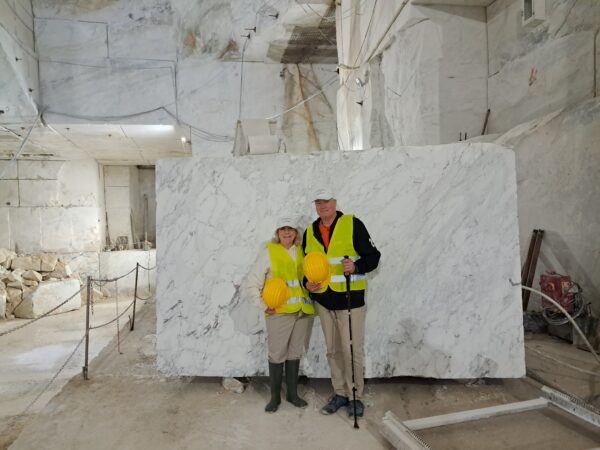
Our private visit to a family-owned marble quarry in Massa involved a Jeep ride up a steep, graveled mountain road with many switchbacks and no guardrails and spectacular views. We were provided wading boots and construction hard hats for entering the caves of the quarry. The caverns are white with slashes of the famous gray, ochre and green characteristics that are hallmarks of this beautiful stone. One can’t help but kept think about elegant marble bathrooms and countertops while walking through.
The “pinch us” moment was tasting wines from Azienda Agricola Podere Scurtarola that were cellared in the marble “tanks” cut and created from the walls of the quarry caves. Vintner Pier Paolo Lorieri also shared slices of his homemade Colonnata lardo, a regional specialty of cured meat pork fat named for a local village and aged in olive oil with wild local alpine herbs and spices. Historically, this calorie-rich lardo has been served to quarrymen to give them energy during their intense manual labor. And there was more local Pecorino and other artisanal local salumi served atop large slabs of marble.
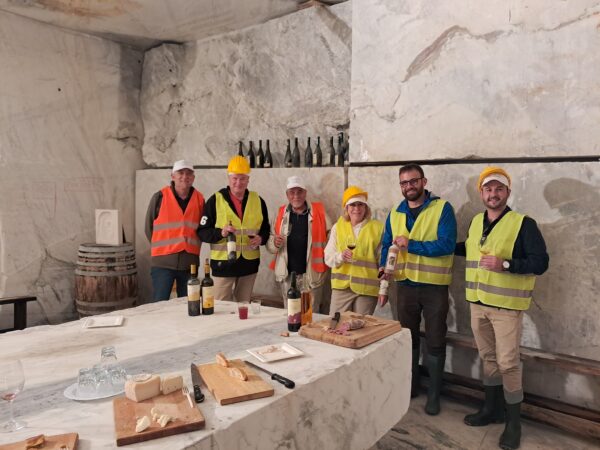
Tasting wines in the marble quarry
This was a private tour for us as this particular marble cave – one of hundreds in these mountains – is a working quarry and not open to the public. For those wanting to see where and how marble is cut from the mountains, tours can be arranged to the nearby Carrara quarries which is well worth it. We also recommend the outdoor museum nearby which tells the history of the quarry industry. It is run by a marble sculptor who also has a small giftshop onsite. Of course, there are plenty of white marble souvenirs to purchase from roadside shops in the area.
Heroic Viticulture
The DOC Candia dei Colli Apuani, established in 1974, is home to about thirty-five wine producers. Many qualify as heroic viticulturists, a term that refers to cultivating vines and making wines in isolated areas with extreme and challenging environments. According to the Centre for Research, Environmental Sustainability and Advancement of Mountain Viticulture (CERVIM) “a vineyard can be classified as heroic if it meets at least one of the following criteria: minimum 30-degree slope inclination, altitude above 500 meters from sea level, terraced vine cultivation and vineyards located in isolated or remote sites such as volcanos, islands and remote mountains.”
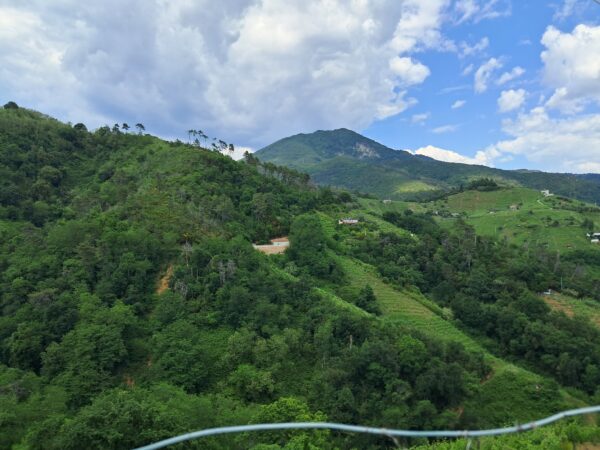
Remote and isolated: the road to Podere Scurtarola, an example of heroic viticulture
Azienda Agricola Podere Scurtarola
A good example of heroic viticulture is Azienda Agricola Podere Scurtarola. Its family owner is Pier Paolo Lorieri who also serves as president of the Strade del Vino del Olio del Sapori di Toscana, the organization that arranged our trip. Lorieri calls himself both an “artisan and anarchist” winemaker. He plays by his own rules and makes wines with minimal intervention and native yeast. Everything is one hundred percent organic. Considered one of the foremost experts on the cultivation and production of Vermentino, Lorieri also cultivates fifty-four experimental grape varieties and has worked hard to resuscitate indigenous ones such as Vermentino Nero and Massaretta, both of which we tasted.
Scurtarola means “shortcut” in the local dialect of the Apuan Alpes. But there are no short cuts on the steep drive up to Azienda Podere Scurtarola, a simple farmhouse with stunning views of the sea and mountains. Pier Paolo took us on a walking tour of the steep terraced vineyards, stopping every so often to inspect the vines and pull away leaves. As we trudged up and down the steep slopes and narrow steps, pausing to take our breaths and sips of water, Lorieri kept going, nimble as a goat. He told us one reason he was inspired to focus on organic cultivation was due to the fact that he had an adverse reaction to pesticides and herbicides. If chemicals were impacting his health, what about the health of the vines?
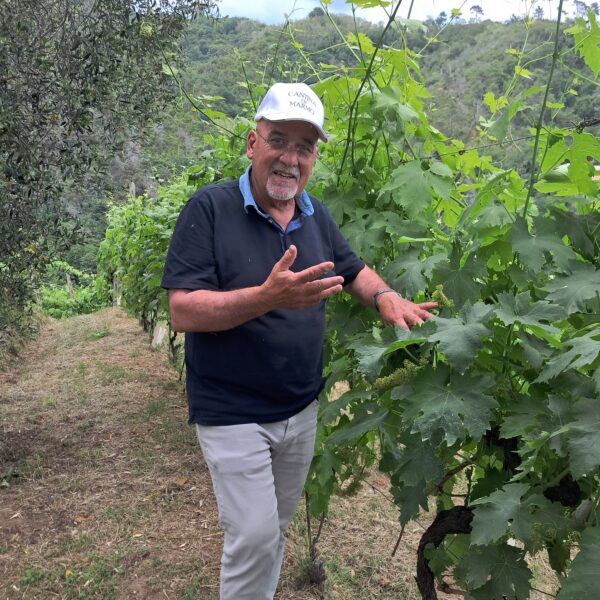
Pier Paolo Lorieri in his vineyards
Podere Scurtarola’s production is only 25,000 bottles annually and is sold mainly to local restaurants and those visitors with the fortitude to make the drive up the mountain for visit. His viticulturist, Michaelangelo Maria Tesconi, traveled with us a portion of the time, including up to the marble quarry, where he oversees the cellar they have created to find out how wine ages in extreme underground environments.
Wines we tasted:
Being a Vermentino specialist, Lorieri took us into his cellar to taste barrel samples of vintages 2020-2025. Lorieri has Vermentino vintages dating to 1989, which we tasted in the marble quarry. We also tasted a Lorieri Vernero Vermentino Nero 2012 IGT Toscana, a native variety Lorieri has helped recover from near-extinction. This vintage was aged 60 months in barrel.
Lorieri Brut Metodo Classico 2021 IGT Toscana. A blend of Vermentino (80%) and Chardonnay (20%), aged 48 months of lees.
Masaretta 2024 IGT Toscana. In nearby Liguria, this variety is known as Barsaglina. It is a dark-skinned variety that produces deep ruby color wines with notes of black cherry, lovage and mint with firm tannins.
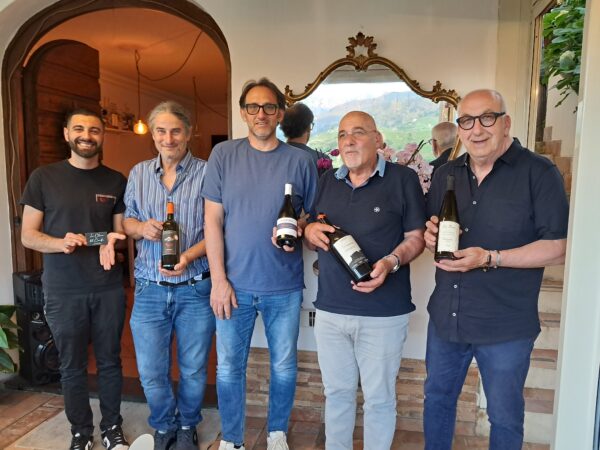
Producers from the Candia Hills
That evening we dined with five local producers at La Chicca del Candia, a small, remote restaurant serving with traditional dishes. Momma Michela cooked our meal; her son Matteo served the food and hung out with the five producers at our table. A standout dish was the margheritine “little daisy” pasta stuffed with spring asparagus and ricotta drizzled with local extra virgin olive oil.
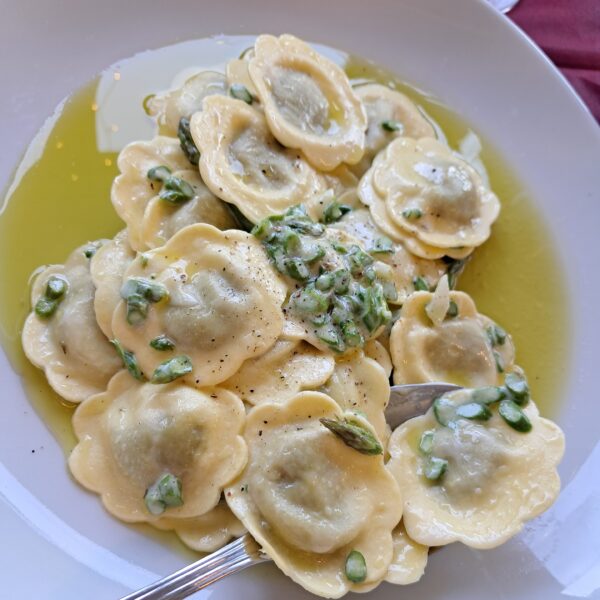
“Little daisy” pasta with spring asparagus and ricotta drizzled with local extra virgin olive oil.
There was also a traditional meat ravioli, and an assortment of small plates including mussels stuffed with mortadella and cheese, fried bacalao (cod), house-made picked vegetables, and an assortment of crostini and salumi. During the dinner, we tasted wines from three local producers – Calevro, La Bura, Lodolina – along with more wines from Lorieri (Scurtarola).
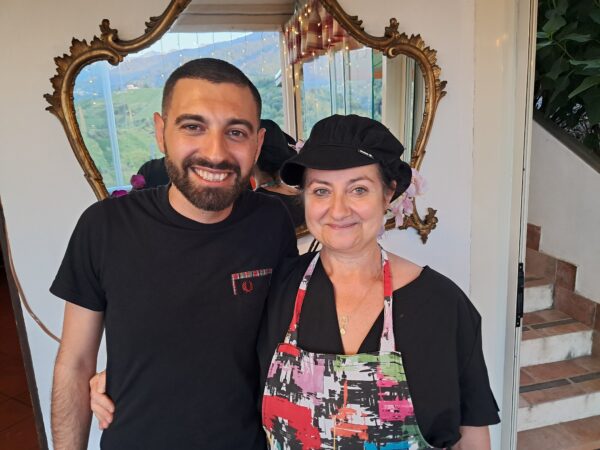
Matteo and his Momma, Michaela, La Chicca del Candia
Where to Stay
The Hotel Excelsior in Marina di Massa is an elegant four-star property with swimming pool and an expansive rooftop terrace overlooking the sea. It is perfect for enjoying an aperitivo or, in our case, Lorieri sparkling wines and antipasti. The hotel’s Executive Chef, Franco Manfredi, oversees all the on-site restaurants, which includes Il Sestante, a top-rated sushi bar. www.hotelexcelsior.it
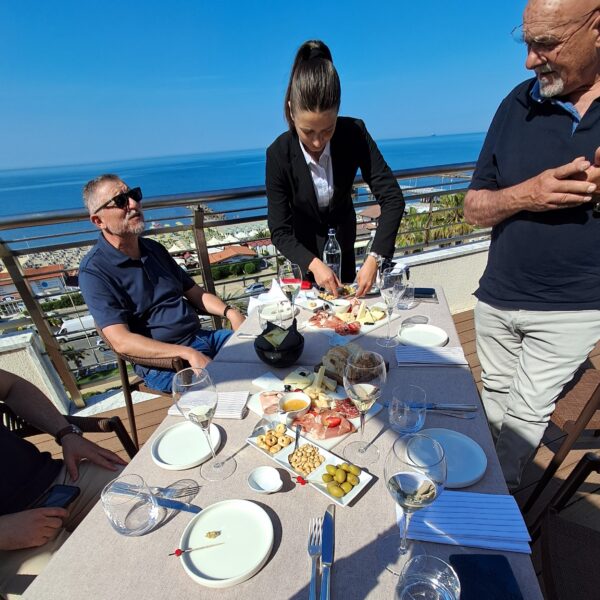
Sipping Lorieri sparkling wines on the terrace at Hotel Excelsior
Dining
There are numerous eateries in Marina di Massa. Our one night in town found us at Ristorante La Peniche, an elegant seafood restaurant located over the water and within walking distance of the Hotel Excelsior. The restaurant’s owner, Emiliano Della Bonna, greeted Pier Paolo Lorieri as an old friend (Lorieri seems to know everyone in this area). We dove into a shared grand platter of crudo before having a delightful seafood pasta dish, all paired with local Candia wines. www.lapeniche.com
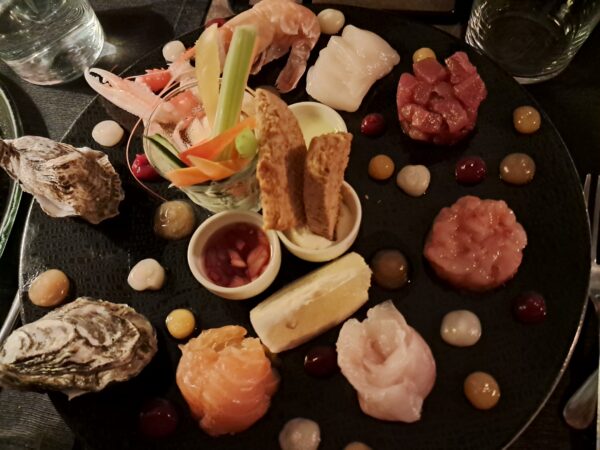
Crudo platter at La Peniche
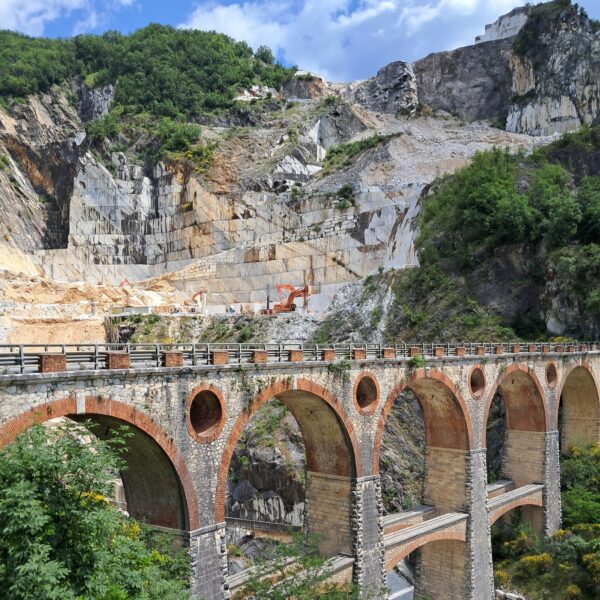
Bridge near Carrara marble quarry
Information on Tuscan Wine and Food Trails in this region can be found at these websites:
Candia Consortium of the Apuan Hills