
In Greece’s northern Peloponnese about two hours’ drive from Athens, is the PGI Slopes of Aigialia (a.k.a. Egialia), a visually stunning area of lands carved by steep mountains, plateaus and gorges, that quickly give way to the shores of the Corinthian Gulf. The altitude curve is steep, some five kilometers, as the crow flies, brings you from sea level to 3000 feet. This intersection of isolated mountains with the Gulf waters provides an ideal microclimate for cultivating grapevines.
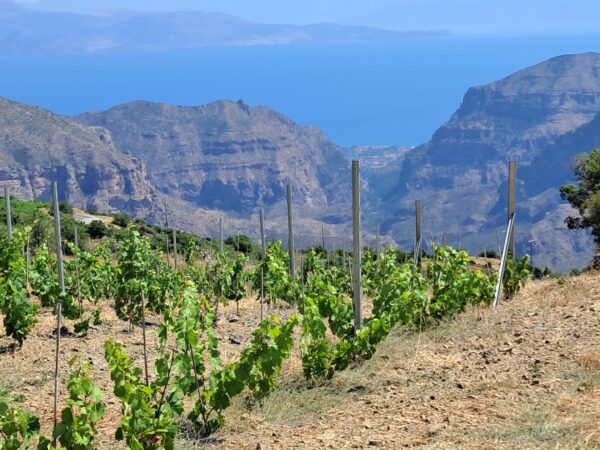
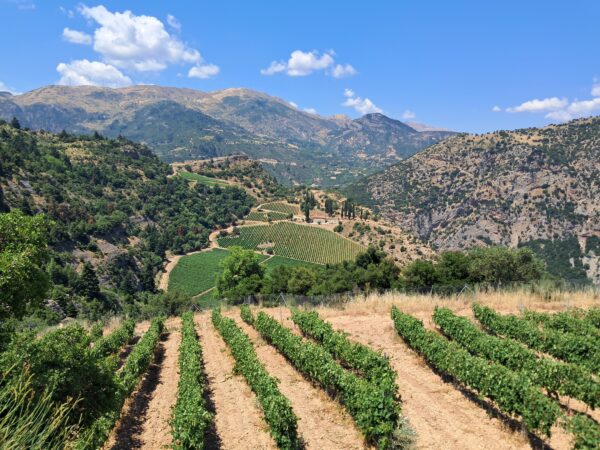
Rouvalis Winery vineyard in the PGI Slopes of Aigialeia. In the distance is the Corinthian Gulf.
Officially classified as a PGI in 1997, Slopes of Aigialia (pronounced: eh-yee-a-lee-a) is towered by four mountains, each over 6000 feet, and four plateaus. Throughout the area are deep gorges cut by seven rivers and various ancient sea terraces. The area was once covered by the sea, and the alluvial soils have marine fossils. Summers are hot and dry with cooling breezes amid the mountain ranges. Winters can bring snow and much needed water. This area is also home to Kalavryta Ski Center.
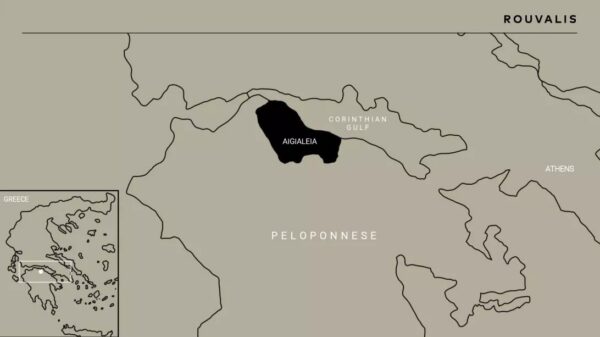
Aiglaleia hugs the Corinthian Gulf. Map: Rouvalis Winery
Here vintners practice “heroic viticulture,” defined as high-altitude vines (above 1600 feet) planted on steep, usually terraced, slopes in poor soils, and often located in isolated regions. Aigialia is a small production area with only five wineries. In July 2026, we visited three of them: Rouvalis, Tetramythos and Mega Spileo Estate. All work with native varieties, some quite rare, and they experiment with international varieties, producing impressive results unique to this production zone. Here is a snapshot:
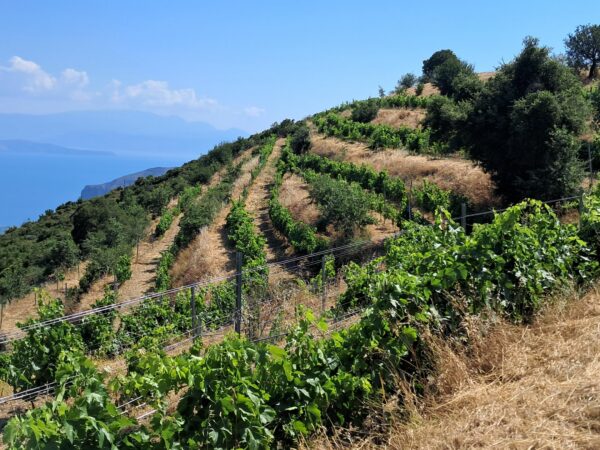
Rouvalis Vineyard
Rouvalis Winery
Rouvalis Winery was founded in 1990 by Angelos Rouvalis, who is considered a pioneer in Greece’s modern winemaking. His daughter, Theodora Rouvalis, now runs the family winery with her partner, Αntonio Ruiz Pañego. Both are oenologists with extensive experience working at wine estates in Bordeaux, Burgundy, Alsace, New Zealand, Chile and Spain, the latter where they met. The two form an impressive partnership as we earned over a seaside lunch. Theodora drove us through steep canyons to Rouvalis’ highest vineyards, reaching 1200 meters. Terraced vineyards face north, something unique to this region. The diurnal weather pattern and rocky soils are ideal for growing many varieties.
Rouvalis works with indigenous Greek varieties such as Roditis, Malagousia, Assyrtiko, Tsigello (a clone of Mavrodaphne), Malvasia and the rare Kydonitsa. The latter is used to produce a sweet passito wine made from sun dried grapes fermented in French oak for twelve months. International varieties cultivated include Riesling, Sauvignon Blanc, Chardonnay, Viognier, Merlot, Cabernet Sauvignon and Syrah. One of the most interesting aspects of our visit at Rouvalis was tasting their different and nuanced renditions of 100% Roditis and 100% Tsigello wines, one from grapes blended from different vineyards and the other being single vineyards. V.O.S. Selections is the main U.S. importer. www.rouvaliswinery.gr
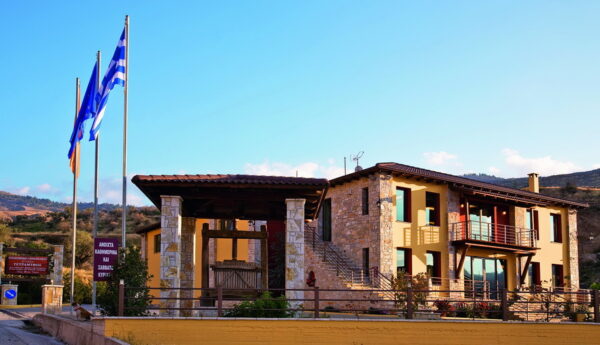
Tetramythos Winery
Located on the slopes of Mount Aroania, Tetramythos is a boutique winery that attracts 12,000 visitors annually. Tetramythos was started in 1994 by brothers, Aristos and Stathis Spanos, who grew up in this area of the Peloponnese. In 1999 they partnered with local oenologist Panagiotis Papagiannopoulos and over the years planted new vines. The current winery and tasting room were completed in 2004. Papagiannopoulos, soft-spoken and cerebral, led us through our tasting. At Tetramythos the focus is on minimal intervention, exclusively monovarietal wines with both native and international varieties.
After tasting through the wines with Papagiannopoulos, we understand the appeal. We were particularly struck by those using native varieties, notably the Roditis Natur, an orange wine, and a Restina Anfora Natur made with Roditis. Mavro Kalavrytino is an example of ancient red grape rescued from near-extinction, that produces lighter red quite similar to a Pinot Noir. Another rare grape of this region that Tetramythos works with is Vol’itsa, a single vineyard wine produced from old bush vines. This wine undergoes carbonic maceration; the result is a fresh, fruit red with notes of blueberry and cherry. Just all the wines here are exceptional. We also took home a bottle of Tetramythos’ monovarietal olive oil. Tetramythos works with several U.S. Importers which are listed on their website. www.tetratmythoswines.com
Mega Spileo Estate
Mega Spileo Winery
Deep in the Chelmos-Vouraikos National Geopark, Mega Spileo is the name of both a winery and one of the world’s oldest continually occupied monasteries whose history intersects in the twentieth century. The Greek Orthodox Mega Spileo Monastery was established in 362 A.D. by two monks, Symon and Theodore, brothers from Thessaloniki. Over two millennia, various wars, four destructive fires and decreasing faithful have taken a toll, but Mega Spileo Monastery remains open and occupied, albeit with fewer monks over time. As the monastery’s population declined in the twentieth century, so did their ability to maintain its sizeable vineyards.
In 1999, brothers Giannis and Theodoros Anastasiou, owners of CAVINO wine group, acquired a long-term lease from the Estate of the Monastery. The brothers replanted vines and established The Mega Spileo Estate. Vineyards are planted on different slopes and altitudes throughout the property, as we saw when we took a tour. At the tasting room, there is a remnant of an original winemaking facility. However, the wines themselves are made at a separate CAVINO facility under direction of head oenologist, Stelios Tsiris, who oversees all the brands. Mega Spileo Estate wines serve as his creative think-tank where he can experiment with different varieties. As a result, Mega Spileo has more than twenty labels, both monovarietal and blends.
Here we also tasted Mega Spileo’s “Mystic” brut and rose sparkling wines and several vintages of their estate Assyrtiko, a variety more widely planted in Santorini, but Tsiris likes to experiment. Another of his experimental wines that caught our eyes and palates is a red wine made from Vertzami, a variety more widely planted on the Ionian Island of Lefkada. This wine is extremely limited production and has notes of ripe red berries, pine, eucalyptus and garrigue. Mega Spileo produces both a monovarietal Cabernet Sauvignon and Pinot Noir; however we are partial to the wines using native varieties, notably the flagship Estate Grand Cave, a Mavrodaphne blend. We also tasted an excellent late harvest botrytis Sauvignon Blanc with notes of honey and almond from Mega Spileo’s Iconic Wines label. Mega Spileo wines and distribution can be found on their website. www.megaspileo.gr
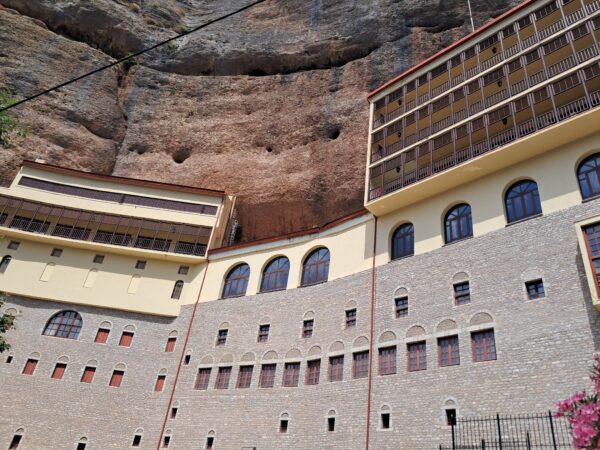
Mega Spileo Monastery is built into the side of a mountain.
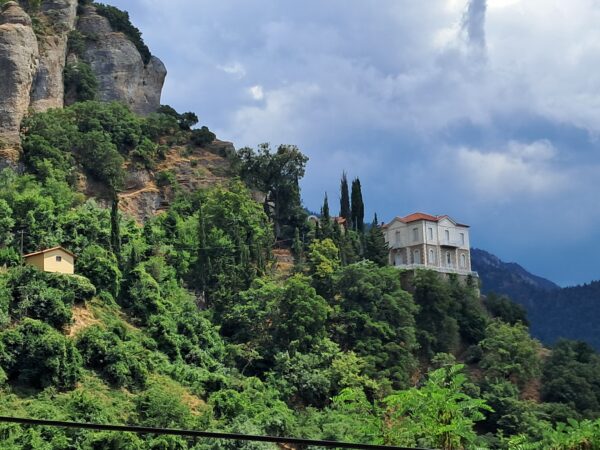
The 1909 Guest House is on the property at Mega Spileo Monastery
Planning this trip on our own, we reached out to Sofia Perpera, who has worked with the Greek Wine Federation for more than twenty-five years. We have met Sofia on several occasions at Greek wine events in New York and trusted her recommendations. She proposed renting a car and venturing either to the well-known Nemea and Mantinia PDO regions or to Aigialeia. We decided to head to the mountains of Aigialeia after reading about these fascinating wineries and, hopefully, to avoid packaged wine tours. We chose the road less traveled, and it made all the difference.
Watch this episode of The Connected Table TV on YouTube about the Aigialea wine region.
Listen on iHeart Radio on your preferred podcast channel. The Connected Table audio podcast can be heard on more than 64 channels worldwide.